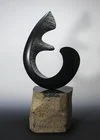
Minarai - Apprentice
Early this year (2025) I had the opportunity to travel to Japan and work in the studio of the master granite sculptor Keizo Ushio. I have been inspired by Keizo’s work since stumbling across his large black granite sculpture "Oushi Zokei Madoka" at the Port of Seattle. This fascinating work composed of two twisted interlocking mobius forms cut from a single massive granite block presented a puzzle. Having just started my journey into carving hard stone I was intrigued by this sculpture and continued to follow Keizo’s work as I began to pursue my own style.
In the fall of 2024 as I was going stir crazy in my apartment rehabilitating a broken shoulder I saw a post from Keizo opening a call for studio assistant applications and I responded without hesitation. The injury put me in a tough place where I was questioning my ability to even continue carving stone but over the next few months we continued our correspondence I strengthened, healed, and prepared. Before I knew it I was on a plane to Japan ready for the adventure of my lifetime in carving.
On day one of my arrival I was given the orientation at Keizo House which was to be my residence for the duration of my 9 week stay. In our email correspondence Keizo had referred to the house as a “mansion” and I chalked that up to another of the many frequently comical descriptions that are so often lost in translation between Japanese and English but it proved more accurate than I could have expected. In his travels through Europe he had learned of the practice of aristocratic patronage where royals in castles would house resident artists and thought, "I'd like to do the same”. There being a deficit of castles on the market in Japan he settled for a 150 year old bank. The house alone is worthy of an entire photo book. It is built on a stone foundation hand cut from blocks carted in from the quarries by animals, framed with hand joined timbers, and filled with amazing sculpture and beautiful gardens. I was transported back in time to a Meiji era sculpture gallery, given the keys, and firmly instructed not to burn the place down.
From Keizo house the sculpture studio was a 20 minute commute in a tiny blue car on the wrong side of the road. The studio occupies a retired volcanic tuff quarry and Keizo has been operating there for 37 years. It is beautifully equipped with cranes and lifts and a custom engineered trio of wire saw, bridge saw and articulated core drill. Massive twisted granite forms in all stages of production dominate the space. A short stroll to the adjacent quarry reveals Keizo Sculpture Park where I could sit and eat lunch and ponder the amazing collection of beautiful finished works. Here I was introduced to Abe, Keizo’s right hand man of 30 years. The plan was for me to produce a version of one of Keizo’s iconic mobius forms from start to finish in tandem with Abe who would also be doing a version of the same form. This allowed the opportunity to learn every technique hands on while also being able to learn by watching the same process in parallel. Abe was fantastically patient and a fantastic teacher even though we had almost no shared verbal language. Those of us who have worked in active stone studios know that with all the protective gear and loud noise most communication boils down to pointing and grunting regardless of language anyways.
Over the weeks of working I learned so many techniques from the dreaded “yon-mai ba” 4 bladed grinder to “nomi-kiri” chisel texture. This all culminated with learning Keizo’s signature technique “enkiri”. Enkiri is an evolution of quarry drilling methods that allows for completely cutting or separating stone in complex curves. The classic half-twist mobius geometry of the piece I was carving has an interesting property where the entire form can be completely cut along its length and remain connected as one continuous band, the negative space of the cut itself also being a mobius. This was achieved with the enkiri technique and required drilling hundreds of holes in two connected bands from both sides around the sculpture. Keizo is the master of this technique and wanted to pass this on more than any other. I am so grateful to have this ability now and look forward to employing it and continuing to develop it in my own work.
Keizo was so generous with his time and resources and knowledge. I immensely enjoyed all our time in the studio and driving through the countryside, touring museums and his public sculpture installations, or just grabbing a ramen bowl at a gas station and eating in the car together. While I learned so much from him about stone carving technique I learned more about philosophy, and culture, and art, and making a life as an artist. I am forever grateful to Keizo Ushio and everyone that supported me along this adventure.
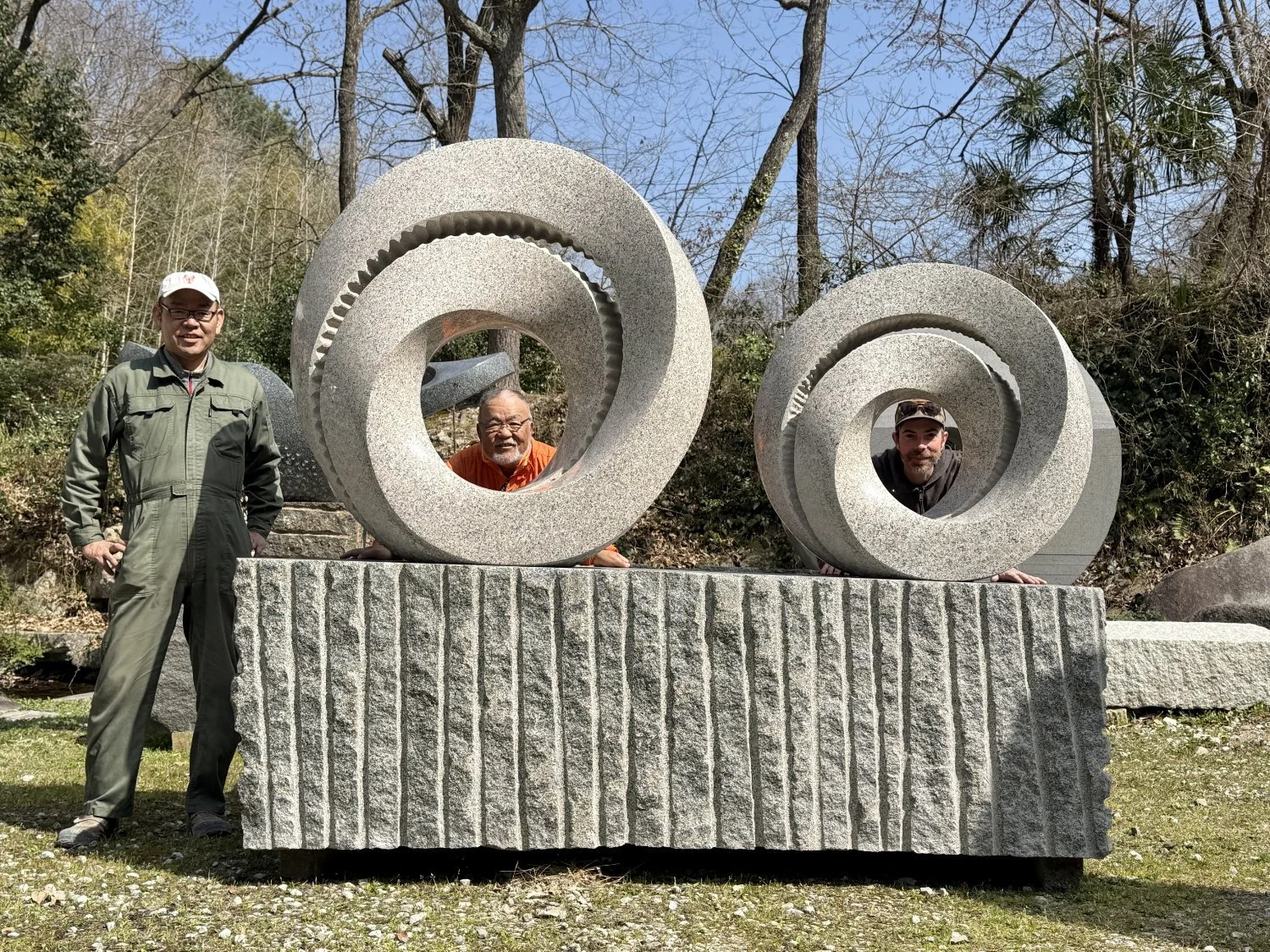
Abe, Keizo, and Jeremy with completed works